

Macroscope
Quarterly Macro & Market Review
4Q 2025
By Sophie Metulescu and Dimitri Stromback
Market Performance
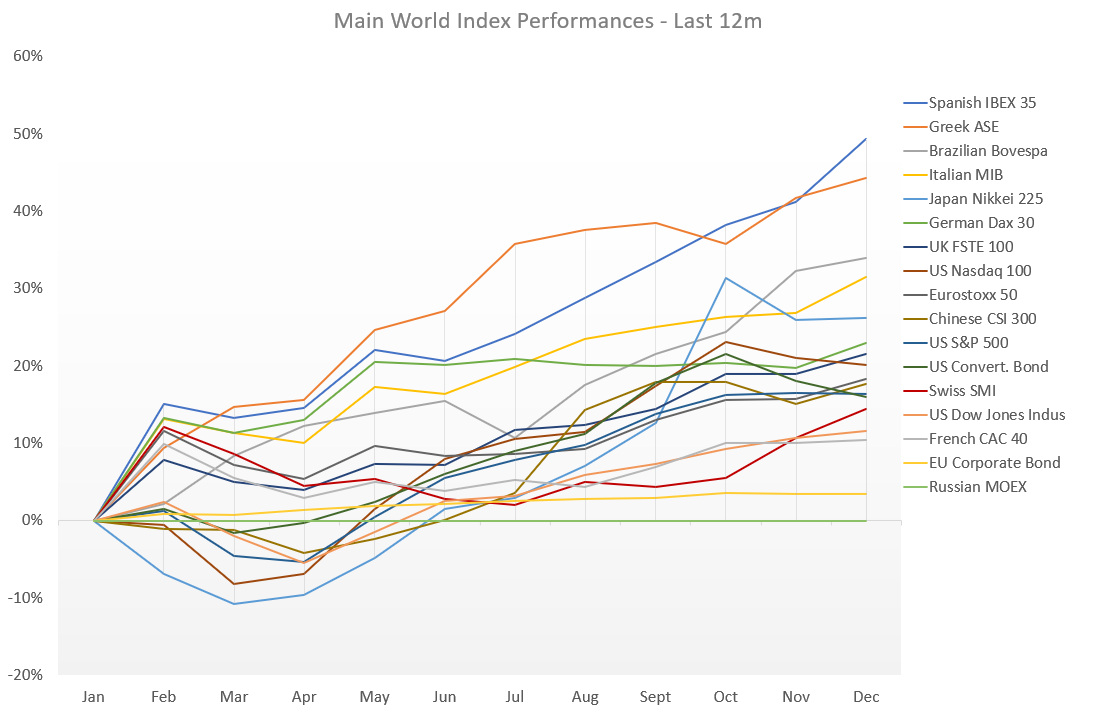
Data source: Bloomberg. Performances in base currency.
Macroscope
Quarterly Macro & Market Review
4Q 2025
– EQUITIES

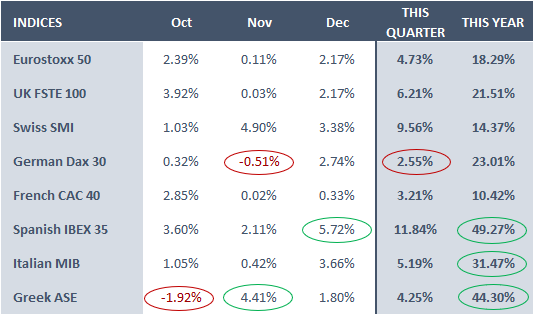
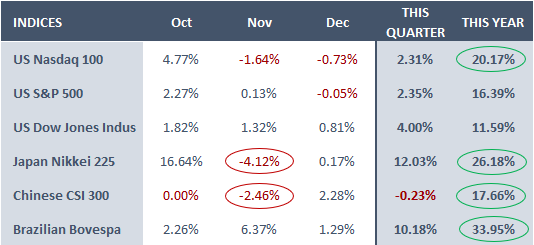
Continued central bank easing and solid earnings growth helped sustain equity appetite globally. Global markets posted steady gains during the fourth quarter of 2025, with several equity indices finishing the year near record or multi-year highs and capping a strong period for risk assets overall.
For the first time in years, non-US equities significantly outperformed the US market for the full year. A weaker US dollar, attractive valuations outside the US and a rotation away from US tech stock contributed to strong gains in Europe, Asia and emerging markets.
Sources: Schroeders, Bloomberg, Yahoo Finance, JP Morgan, Reuters
In Europe
-
Quarter in review: European equities outperformed U.S. markets during Q4 2025 as easing macro headwinds and attractive valuations supported investor sentiment despite elevated geopolitical uncertainty.
-
Full-year 2025: Economic conditions stabilized over the year, leading to more favorable investing conditions and helping European equities deliver strong relative performance.
-
Top-performing sectors: Financials performed particularly well, benefiting from lower interest rates that improved lending prospects, while cautious investors favored healthcare and utility stocks for their stable cash flows and reliable dividends.
-
Laggards and concerns: Interest in growth and technology stocks declined due to high valuations and sector-specific risks, even as security and defense benefited from persistent geopolitical tensions.
In the US
- Quarter in review: U.S. equities advanced in Q4 2025 despite the longest government shutdown on record and rising job cuts, though year-end volatility reflected profit-taking rather than weakening fundamentals.
- Full-year 2025: Even after the April selloff triggered by tariff announcements, the S&P 500 rose nearly 18%, marking a third consecutive year of double-digit returns, supported by easing monetary policy expectations.
- Top-performing sectors: Communication services and technology led again, while industrials, financials, healthcare, and utilities delivered strong double-digit gains as markets broadened beyond mega-cap growth.
- Laggards and concerns: Several “Magnificent 7” stocks underperformed the broader market, highlighting investor caution toward elevated tech valuations and growing doubts about the sustainability of AI-driven returns.
In the UK
-
Quarter in review: UK equities performed well in Q4 2025, building on earlier gains and ending the year near multi-year highs, supported by large, internationally focused companies.
-
Full-year 2025: It was one of the strongest years in over a decade, with the FTSE All-Share rising 33% in USD terms, driven by global earnings exposure and attractive valuations versus U.S. markets.
-
Top-performing sectors: Financials, mining, defence, and other commodity-linked sectors led performance, benefiting from strong global demand, elevated commodity prices, and a slightly weaker pound.
-
Laggards and concerns: Domestically exposed UK companies lagged as consumer spending remained under pressure and cost challenges continued to weigh on profitability.
In the Rest of the World
-
Quarter in review: EM equities delivered positive returns in Q4 2025, outperforming developed markets as Fed rate cuts eased global financial conditions.
-
Full-year 2025: Performance was driven by technology-heavy markets and selective commodity exposure, supported by improving macro conditions in several regions.
-
Top-performing sectors: Korea and Taiwan led gains on strong AI-related demand, while Chile and South Africa benefited from rising commodity and precious metals prices.
-
Laggards and concerns: China declined as profit-taking, weak macro data, and renewed property-sector stress weighed on sentiment, while Saudi Arabia posted the largest losses.
Macroscope
Quarterly Macro & Market Review
4Q 2025
REVIEW BY ASSET CLASS
– FIXED INCOME & FISCAL POLICIES
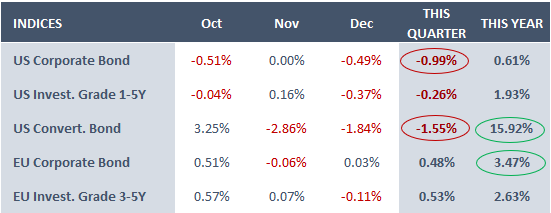
Credit markets stayed resilient in Q4 2025 despite volatility in government bonds. Investment-grade credit posted positive returns, with euro and sterling IG outperforming government bonds. In the US, IG spreads widened (so IG bonds lost value) early in the quarter on banking concerns but later narrowed as market sentiment improved, leaving returns broadly flat versus governments. Steady demand and stable fundamentals supported credit markets.
Overall, corporate credit outperformed sovereign bonds again this quarter, as investors remained willing to take credit risk in a more supportive market environment.
Sources: Eurostat Data, the US Bureau of Economic Analysis, Reuters

In Europe
-
The ECB kept rates unchanged throughout Q4, holding the deposit rate at 2.00% after its June 5 cut from 2.15%.
-
President Lagarde’s comments hinted at reduced conviction about further rate cuts as inflation is stabilizing around the ECB’s 2% target.
-
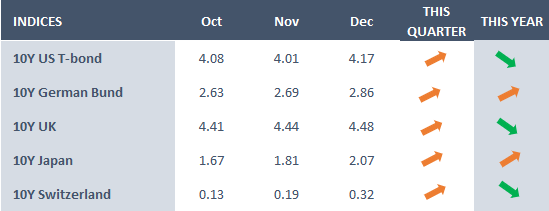
German treasury bond yields fell slightly. Germany’s defense/infrastructure stimulus are expected in 2026, supporting growth but driving inflation.
In the US
-
In Q4, the Fed cut the federal funds rate by 25 basis points in October, followed by a 25 basis points cut in December, lowering the rate to 3.50%-3.75%.
-
Q4 saw the longest government shutdown on record and rising job cuts.
-
Core CPI inflation was reported at 2.8% YoY, while the US economy continued to expand at a solid pace largely through AI-driven investment, underlying consumer price growth remains abover the FED’s 2% target.
In the UK
-
The BoE cut the rate by 25 basis points to 3.75% in a tight vote in December.
-
As of November, the annual inflation rate is 3.2% (down from 3.6% in October). The BoE will evaluate further rate cuts as they try to bring inflation down to their 2% target.
-
UK government bonds and GBP saw sharp volatility around the budget rumour and tax plan uncertainty in November. These fiscal headlines drove FX, rates, and equities simultaneously with gilts particularly sensitive to perceived credibility.
In the Rest of the World
- In late December, the BoJ reduced bond purchases and raised the interest rate by 25 basis points to 0.75% amid fiscal concerns. JGB yields surged highlighting the steepest annual rise (2025) since 1994.
- In China, authorities refrained from further rate cuts in Q4 2025. Stimulus (loan) tools were positioned to support economic activity as the property market kept bond markets depressed. Inflation edged to 0.8% in December driven by rising food and consumer prices.
- In Australia, the RBA held rates around 3.60% in November and December, citing inflation and demand/housing resilience.
Macroscope
Quarterly Macro & Market Review
4Q 2025
REVIEW BY ASSET CLASS
– CURRENCIES: Fiat & Digital
-
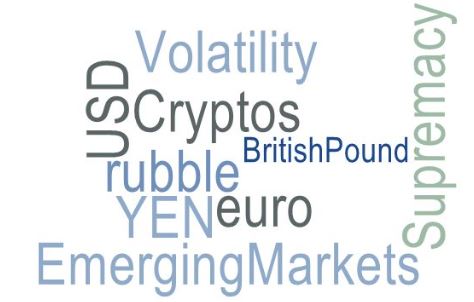
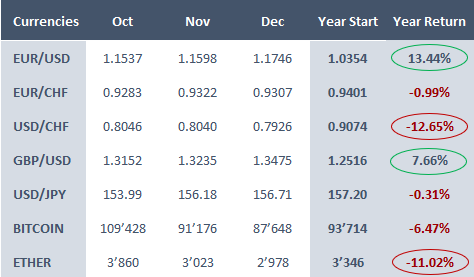
In Q4, the USD showed some resilience on strong US data but remained sensitive to political headlines and debates around Fed credibility, with rate cuts already priced in. News of an investigation into senior Federal Reserve leadership hurt confidence in the Fed and temporarily weakened the US dollar, which ended 2025 down 11.8% versus the euro.
-
EUR and GBP strengthened against the USD, supported by better-than-expected eurozone activity, while GBP remained broadly stable versus EUR as UK–eurozone yield spreads narrowed.
-
The JPY weakened further to multi-year lows, weighed down by political uncertainty and expectations of looser fiscal and monetary policy, despite rising JGB yields.
-
Digital assets rallied into late Q4, with BTC near $95,000 and ETH around $3.3k, benefiting from USD volatility and stronger risk appetite. Post-ETF integration, crypto behaved increasingly like high-beta risk assets, moving more closely with equities.
Macroscope
Quarterly Macro & Market Review
4Q 2025
REVIEW BY ASSET CLASS
– COMMODITIES
-
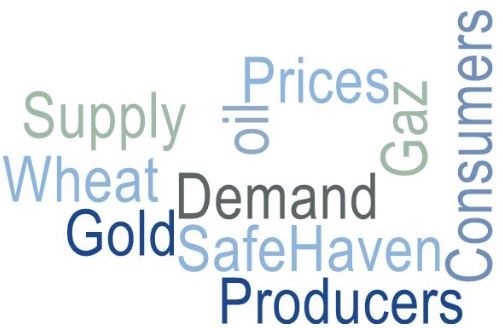
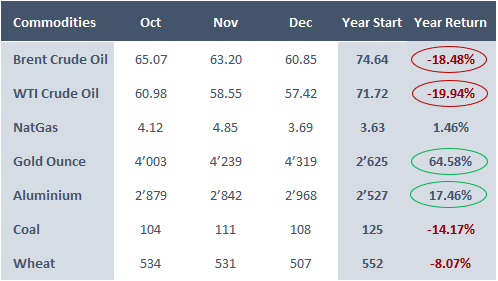
Precious metals: Gold (+65% YTD) and silver (+144%) were the standout performers in 2025, benefiting from geopolitical uncertainty, a weaker USD, moderating inflation, and slower growth expectations, with silver additionally supported by tight supply and strong demand from solar, EVs, and AI infrastructure.
-
Industrial metals: Copper (+40%) and lithium (105%) posted strong gains, driven by supply constraints and rising demand linked to electrification, grid investment, battery storage, and data-centre expansion, particularly in China.
-
Energy: Energy markets underperformed as oil prices fell sharply due to global oversupply, rising OPEC and non-OPEC production, and softer demand growth amid slowing economic momentum.

Macroscope
Quarterly Macro & Market Review
4Q 2025
IN THE FUTURE
– WHAT THE SPECIALISTS SEE FOR 2026
Andrew Bailey, Governor, Bank of England
“Today’s decision should not be interpreted as the start of a rapid sequence of rate cuts. The risks to inflation persistence remain, particularly from wages.”
Jamie Dimon, CEO, JPMorgan Chase
“Geopolitical risk is extraordinarily high right now. Markets appear to be pricing a fairly benign outcome, but that is not a guarantee.”
Ray Dalio, Founder, Bridgewater Associates
“The biggest risks remain fiscal sustainability and geopolitical fragmentation, which markets tend to underprice until they don’t.”
Jerome Powell, Fed Chair
“We have made good progress on inflation, but the Committee does not believe it is yet appropriate to declare victory. Policy decisions from here will depend on how the data evolve.”
Steven Schwarzman, CEO, Blackstone
“We are seeing more opportunities as sellers adjust expectations to a higher cost of capital environment.”
Macroscope
Quarterly Macro & Market Review
4Q 2025
FINANCIAL BUZZ
– THE NEW TERM TO MASTER TODAY

Tokenization of T-Bills
The Tokenization of US Treasury Bills
In Q3, stablecoins dominated the discussion, but in Q4 the focus shifted to tokenized US Treasury Bills. Investors increasingly questioned holding zero-yield stablecoins when digital Treasuries offer guaranteed yield with lower risk. Tokenized T-Bills gained strong traction, providing yield, lower volatility than crypto, and added utility as on-chain collateral without relying on traditional banking infrastructure.
Macroscope
Quarterly Macro & Market Review
4Q 2025
THE QUARTER AHEAD
– MAIN EVENTS & WHAT TO EXPECT

22-23 January: BoJ Monetary Policy Meeting
The BoJ will meet to assess a possible rate hike
What we can expect:
Markets expect no rate hike, financial market stability matters to the BoJ. Wage sustainability and bond-buying operations remain the center of conversation, as well as any pushback against rapid yield increases.
27-28 January: FOMC Meeting
The FED will vote on a possible rate cut
What we can expect:
The FED cut rates in December 2025 and signaled a slower, more cautious easing path. Inflation remains a concern as CPI index has slightly increased in Q4 2025. The expectation is no rate cut as the FED wants to further scrutinize their data. Powell is expected to push back against aggressive rate-cut expectations.
4-5 February: ECB Governing Council Meeting
The ECB will hold a meeting to assess a possible rate cut
What we can expect:
ECB held rates through late 2025 with inflation near target but weak growth across the Eurozone. Markets expect a rate hold as Lagarde previously emphasized that “we are in a good place”. It is noteworthy to mention the fiscal policy in Germany with increased defense and infrastructure spending.
5 February: BoE MPC Policy Announcement
The BoE will meet to discuss a potential rate cut
What we can expect:
BoE cut rates in December 2025 as UK wage growth was still elevated and fiscal credibility remained a market sensitivity. Markets expect the BoE to hold rates as there is strong resistance against rapid cutting cycles and an emphasis on services inflation and pay growth. However, there is a higher chance of a second 25bps cut in March, as the BoE is seen as the most inflation-constrained of the major central banks.