
Macroscope
Quarterly Macro & Market Review
2Q 2026
By Sophie Metulescu
Market Performance
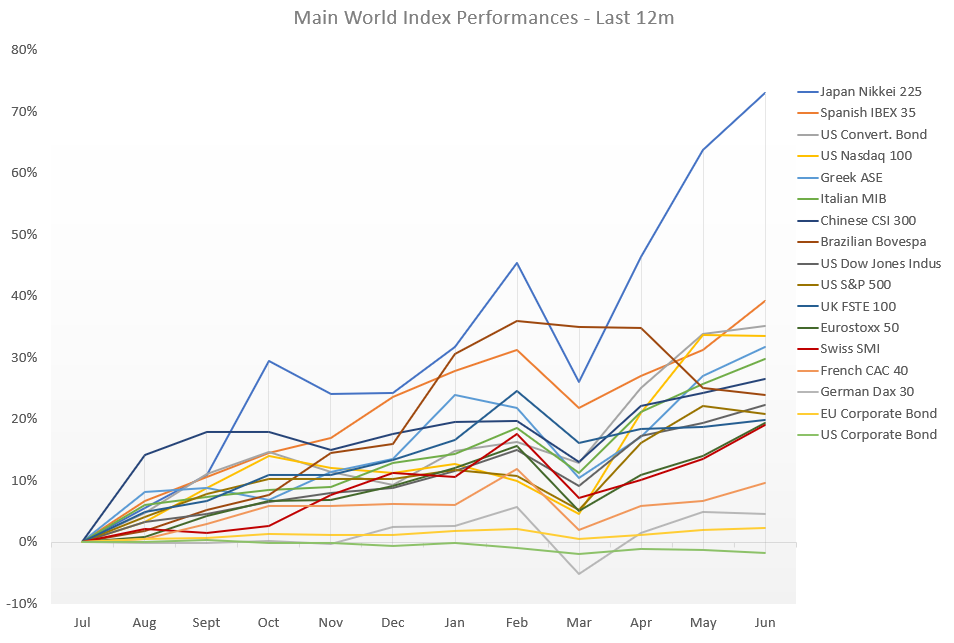
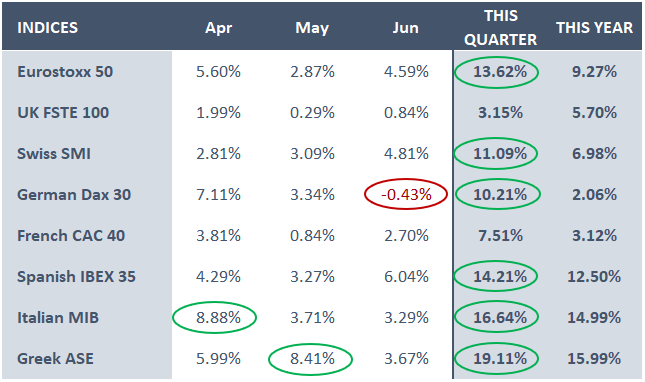
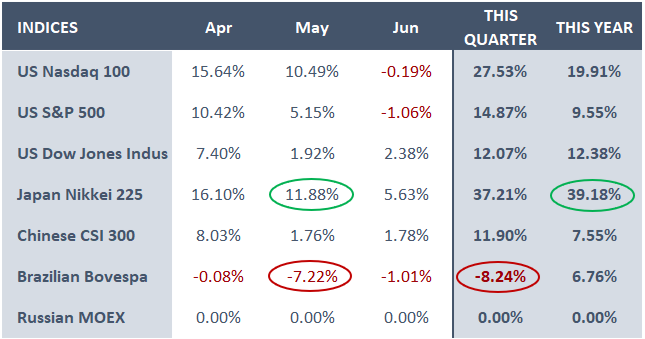
Data source: Bloomberg. Performances in base currency.
Macroscope
Quarterly Macro & Market Review
2Q 2026
– EQUITIES
Global equities rose sharply in Q2 2026, led by renewed optimism around AI capital expenditure and a US–Iran ceasefire that eased tensions in the Middle East.
Markets rallied as energy prices retreated from their highs, cooling inflation fears and reviving risk appetite.
This drove a decisive risk-on shift, with investors rotating back into growth and technology, and Asia ex-Japan leading global gains.
Sources: Schroeders, Bloomberg, Yahoo Finance, JP Morgan, Reuters
In Europe
-
Quarter in review: Eurozone equities rose strongly over the quarter as easing Middle East tensions and resilient earnings lifted sentiment, even as the ECB raised rates in response to above-target inflation from the earlier energy shock.
Top-performing sectors: Information technology and financials led, with IT buoyed by strong corporate earnings and optimism over AI, while healthcare and cyclicals also participated in the rally.
Laggards and concerns: Energy and communication services posted negative returns as oil retreated to pre-conflict levels, while a renewed contraction in eurozone business activity highlighted weak underlying growth.
In the US
- Quarter in review: US equities rose in Q2 2026, with the S&P 500 up 15.2% — its strongest quarter since 2020 — as resilient earnings, AI enthusiasm and a more comfortable inflation outlook broadened the rally beyond mega-cap technology.
- Top-performing sectors: Information technology led by a wide margin, driven by semiconductors and AI infrastructure, with communication services and consumer discretionary also solid.
- Laggards and concerns: Energy underperformed by quarter-end as the US–Iran ceasefire accelerated the fall in oil prices, while inflation and the transition to a new Fed Chair remained sources of volatility.
In the UK
-
Quarter in review: UK equities gained over the quarter, though declines in the heavyweight energy sector capped progress as oil returned to lower levels. Markets showed little reaction to political upheaval as Keir Starmer announced his resignation as prime minister.
-
Top-performing sectors: Consumer discretionary, real estate and financials led gains, supported by steady inflation and firmer risk appetite.
-
Laggards and concerns: Energy was the main laggard as oil prices fell, while inflation at 2.8% kept the Bank of England on hold, with two policymakers already voting for a hike.
In the Rest of the World
-
Quarter in review: Emerging markets rose sharply in Q2 2026, ending well ahead of developed markets and posting their strongest quarter since 2009, led by the technology-heavy markets of Korea and Taiwan on continued AI demand.
- Top-performing sectors: Memory and semiconductor names drove returns, with Korea and Taiwan reaching all-time highs, while smaller markets such as Hungary and Egypt also outperformed.
-
Laggards and concerns: Leadership was narrow: China lagged on mixed data and internet-stock weakness, India was weighed by AI risks to its IT services, and Brazil and Indonesia underperformed on domestic pressures.
Macroscope
Quarterly Macro & Market Review
2Q 2026
REVIEW BY ASSET CLASS
– FIXED INCOME & FISCAL POLICIES
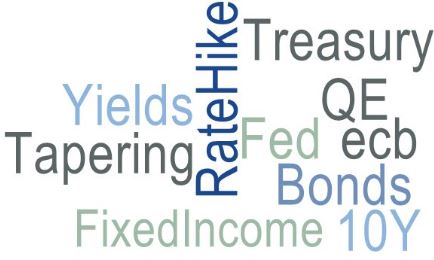
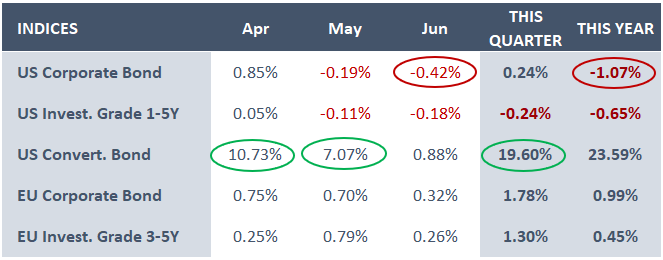
Credit markets rebounded in Q2 2026 as easing geopolitical tensions and falling energy prices calmed fears of a fresh inflation shock and steadied rate expectations. Spreads tightened—the difference between corporate and government bond yields—meaning corporate bonds gained value as investors grew more confident. Robust corporate earnings and firmer risk appetite supported demand for credit, with emerging market debt among the strongest performers.
Overall, corporate credit outperformed sovereign bonds this quarter, as investors added risk exposure in a more settled environment.
Sources: Eurostat Data, the US Bureau of Economic Analysis, Reuters

In Europe
-
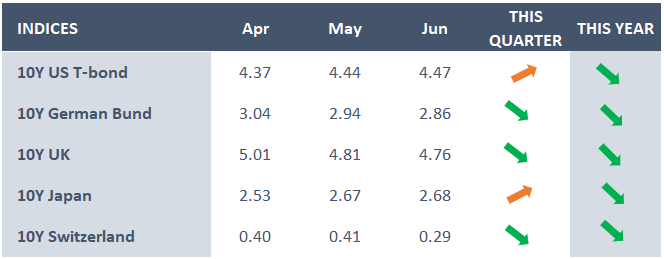
The ECB raised rates by 25bps to 2.25% in June given above-target inflation from the energy shock, while lifting its inflation projections and cutting its growth outlook.
-
German Bunds lagged non-core and peripheral markets, with Greece the strongest performer as investors reached for higher-yielding sovereigns.
In the US
-
The Fed left its target range unchanged at 3.50%–3.75%, maintaining that policy was sufficiently restrictive, with Kevin Warsh approved as Powell’s successor and chairing his first meeting in June.
-
The Treasury curve flattened as stronger-than-expected data — including resilient payrolls — reinforced expectations that policy would stay restrictive.
In the UK
-
The Bank of England kept the base rate unchanged at 3.75%, judging that easier labour market conditions and weaker growth should contain inflation despite energy-price risks.
-
Gilts were volatile: the 10-year yield hit its highest level since 2008 in April, before Keir Starmer’s resignation and a swift succession removed some political risk premium.
In the Rest of the World
- The Bank of Japan raised its policy rate by 25bps to 1.00% in June — its first hike since December — and signalled further tightening was possible if inflation stayed above target. Japanese government bonds underperformed as yields pushed higher.
- Corporate bond supply stayed robust, supported by refinancing needs and AI-related capital expenditure, while firmer risk appetite supported credit more broadly.
Macroscope
Quarterly Macro & Market Review
2Q 2026
REVIEW BY ASSET CLASS
– CURRENCIES: Fiat & Digital
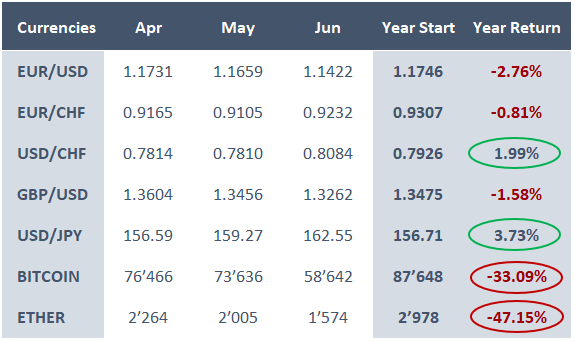
- The USD firmed, supported by the Fed’s hawkish stance and the strength of US tech-led equities, which revived the theme of dollar-positive “US exceptionalism,” as rate expectations shifted toward higher-for-longer rather than cuts.
- The EUR eased against the dollar, slipping back from its late-winter highs even as the ECB delivered its first hike in 11 months to 2.25%, with softer inflation expectations and a weaker growth outlook capping the euro. GBP outperformed, hitting a one-year high, helped by resilient sterling assets and the swift resolution of UK political uncertainty after Keir Starmer’s resignation.
- The JPY stayed weak, touching a near 40-year low versus the dollar, as persistent yield differentials outweighed the Bank of Japan’s 25bps hike to 1.0% and kept the currency a tailwind for Japanese exporters.
- Digital assets fell sharply to pivot into the AI fever through equities — total crypto market cap down ~12.6% and Bitcoin ~14% — as a hawkish Fed, a high US dollar and renewed US–Iran tensions pulled capital out of the sector.
Macroscope
Quarterly Macro & Market Review
2Q 2026
REVIEW BY ASSET CLASS
– COMMODITIES
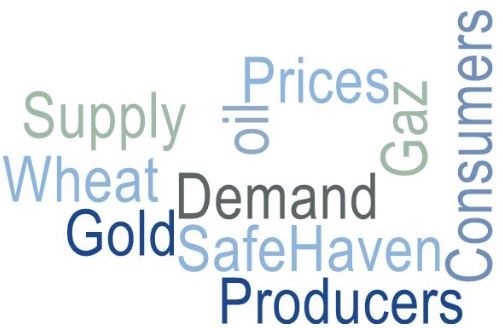
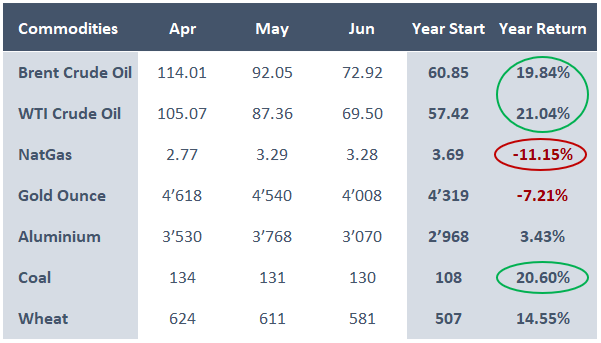
- Commodities fell in Q2, with the S&P GSCI index down 11.4% as the quarter’s risk-on tone played out through lower energy and precious metals prices.
- Energy led the decline as the US–Iran ceasefire pulled oil back from its highs, though shipping through the Strait of Hormuz remained well below pre-conflict levels.
- Precious metals came under pressure, with gold and silver falling as rising inflation expectations made yield-bearing assets such as government bonds relatively more attractive.
- The agriculture component was also weak over the quarter, although cocoa was a notable outperformer.
- Industrial metals were little changed, with gains in copper and zinc offsetting weakness elsewhere.
Macroscope
Quarterly Macro & Market Review
2Q 2026
IN THE FUTURE
– WHAT THE SPECIALISTS SEE FOR 2026
Dr Alexis Crow, Chief Economist, PwC
“Soaring AI capex has emerged as a primary engine for growth.”
Jamie Dimon, CEO, JPMorgan Chase
“The skunk at the party … would be inflation slowly going up.”
Ray Dalio, Founder, Bridgewater Associates
“On the US debt spiral, I believe we are currently on the brink.”
Kevin Warsh, new Fed Chair
“This Committee will deliver price stability.”
Larry Fink, CEO, Blackstone
“The greatest problem we have … is we have just ungodly deficits.”
Macroscope
Quarterly Macro & Market Review
2Q 2026
FINANCIAL BUZZ
– THE NEW TERM TO MASTER TODAY
Do you know what is HBM?
-The Two Korean Chips That Ate the Market-
In Q2 2026, two companies you might not follow closely — SK Hynix and Samsung — did something extraordinary: they tripled and doubled in value, dragging Korean equities to their best quarter since 1998 and crossing the $1 trillion mark. The reason is a single, unglamorous component: high-bandwidth memory, the stacked chips that feed data to AI accelerators. As hyperscalers raced to build out AI infrastructure, HBM became the real bottleneck of the boom — and the “picks and shovels” trade of the quarter. Here’s why memory, of all things, became the market’s hottest asset.
Macroscope
Quarterly Macro & Market Review
2Q 2026
THE QUARTER AHEAD
– MAIN EVENTS & WHAT TO EXPECT

28–29 July: FOMC Meeting
Kevin Warsh’s second meeting as Chair — policy statement only, no new projections.
What we can expect:
With the target range at 3.50%–3.75% and inflation still elevated after the energy shock, a hold looks most likely, but markets are pricing a growing chance of a hike later in the year.
30 July: Bank of England MPC
The BoE decides with Bank Rate held at 3.75%.
What we can expect:
The MPC has held at 3.75% all year, but two members already voted for a hike in June as energy costs keep inflation sticky (CPI 2.8%). With growth soft and a new government under Andy Burnham settling in, the Bank faces an awkward trade-off between weak activity and above-target inflation. A hold is likely, but the vote split and any shift in guidance will move gilts and sterling.
27–29 August: Jackson Hole Symposium
The Fed’s annual symposium in Wyoming; this year’s theme is financial innovation, payments and policy.
What we can expect:
Warsh’s first Jackson Hole as Chair, three weeks before the September dot plot, is a platform to frame his “regime change” and inflation-first stance. Investors will parse his remarks — and any divergence with the ECB, BoE and BoJ governors in attendance — for hints on whether a September move is coming.
10 September: ECB Governing Council
Hosted by the Bundesbank, with updated staff projections.
What we can expect:
After June’s hike to 2.25% — its first in 11 months — the ECB meets with fresh forecasts. Energy-driven inflation argues for caution, while fading eurozone growth (PMIs near contraction) argues against further tightening. Lagarde has stressed a data-dependent, no-pre-commitment approach; the new projections will show whether the Council still sees upside inflation risks.
15–16 September: FOMC Meeting
The quarter’s marquee meeting, with a fresh dot plot.
What we can expect:
This is the most-watched Fed meeting of Q3. In June, nine of eighteen officials signalled support for higher rates this year, and futures now price a better-than-even chance of a hike by year-end — September being the first live date. The updated projections and Warsh’s guidance will set the tone into the November midterms, when the Fed traditionally avoids surprises.
Through Q3: Geopolitics & the Strait of Hormuz
The US–Iran ceasefire and the pace of the Strait’s reopening.
What we can expect:
The de-escalation that drove Q2’s rally remains fragile. Oil and commodity shipping through Hormuz are still below pre-conflict levels; a durable reopening would ease energy prices and inflation, while any breakdown could push Brent higher and revive the inflation scare. It’s the swing factor for every central-bank path this quarter — and with US midterms in November and a new UK government bedding in, the political backdrop only adds to the uncertainty.