
Macroscope
Quarterly Macro & Market Review
1Q 2026
By Sophie Metulescu
Market Performance
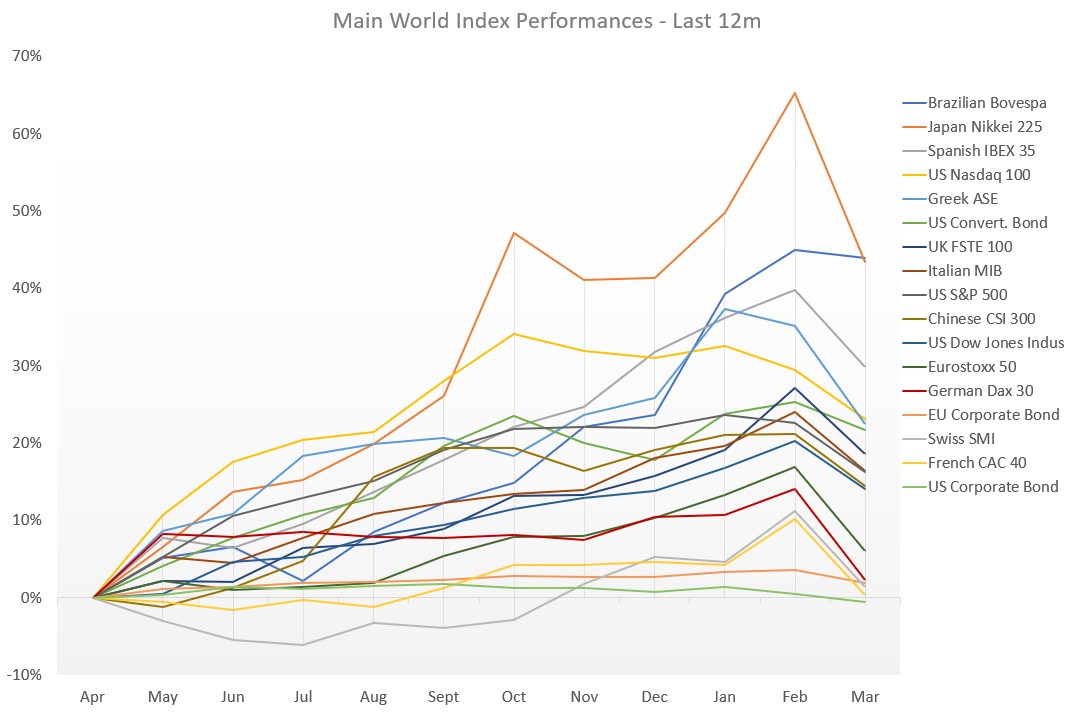
Data source: Bloomberg. Performances in base currency.
Macroscope
Quarterly Macro & Market Review
1Q 2026
– EQUITIES

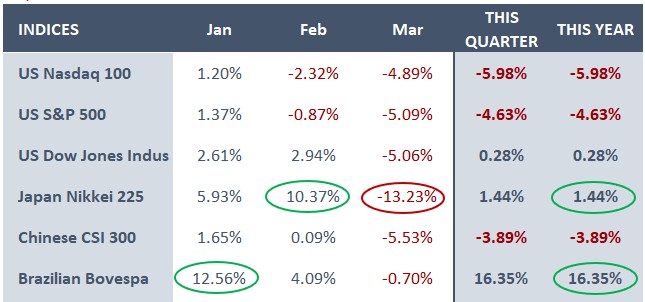
Global equities fell in Q1 2026, led by weakness in US technology stocks and escalating tensions in the Middle East.
Markets reversed sharply in March as the conflict disrupted energy supply, pushing oil prices higher and reigniting inflation concerns.
This triggered a risk-off shift, with investors rotating out of growth and into value.
Sources: Schroeders, Bloomberg, Yahoo Finance, JP Morgan, Reuters
In Europe
-
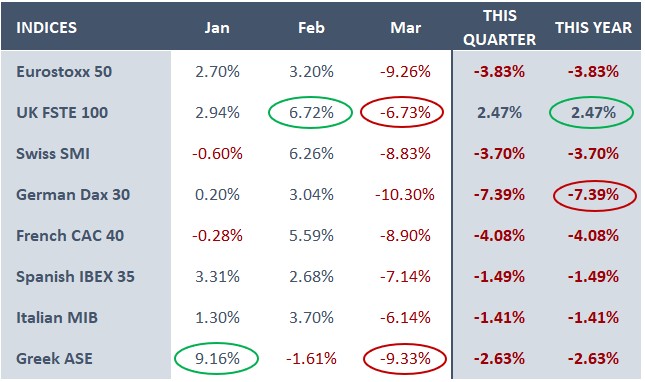
Quarter in review: Eurozone equities declined over the quarter, with losses concentrated in March as the Middle East conflict triggered a sharp rise in energy prices, weighing on sentiment and clouding the outlook for growth and interest rates.
- Top-performing sectors: Energy stocks outperformed, benefiting directly from higher oil prices, while hardware and semiconductor companies proved more resilient following solid earnings.
-
Laggards and concerns: Consumer discretionary stocks declined as growth expectations weakened, while software stocks came under pressure from concerns that AI could disrupt existing business models.
In the US
- Quarter in review: US equities declined in Q1 2026, marking the weakest quarter since 2022. Markets started strongly but reversed as geopolitical tensions and rising oil prices triggered volatility and increased risk aversion.
- Top-performing sectors: Energy and basic materials outperformed, benefiting from higher commodity prices and supply disruptions linked to the Middle East conflict.
- Laggards and concerns: Technology stocks underperformed, particularly software, as concerns grew that new AI capabilities could weaken the SaaS model and as investors questioned the returns on rising AI-related capex.
In the UK
-
Quarter in review: UK equities outperformed in Q1 2026, helped by their strong exposure to energy and commodity-linked companies, which gained from the surge in oil and raw material prices. A weaker sterling also supported large international groups by lifting the value of overseas revenues, explaining the gap between large caps and more domestically exposed stocks.
-
Top-performing sectors: Energy and basic materials led gains as higher prices supported earnings, while healthcare—especially pharmaceuticals—benefited from solid results and continued investment in drug development.
-
Laggards and concerns: Technology came under pressure in line with global trends, while consumer discretionary struggled as household spending remained weak.
In the Rest of the World
-
Quarter in review: Emerging markets held up better than developed markets in Q1 2026 (MSCI EM -0.1%), but the quarter split in two: strong gains early on, followed by a sharp sell-off in March. Momentum initially came from AI-driven demand in Korea and Taiwan, before the surge in oil prices reversed sentiment.
- Top-performing sectors: Technology names linked to AI led early gains, while Latin America benefited from higher commodity prices.
-
Laggards and concerns: The spike in energy costs hit import-dependent economies across Asia, triggering a broad pullback. China also lagged, weighed down by weak growth and pressure on internet stocks.
Macroscope
Quarterly Macro & Market Review
1Q 2026
REVIEW BY ASSET CLASS
– FIXED INCOME & FISCAL POLICIES
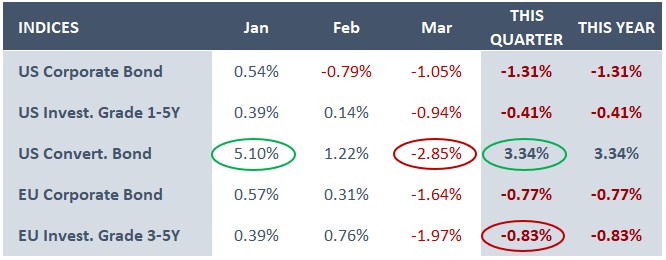
Credit markets came under pressure in Q1 2026 as rising energy prices and geopolitical tensions shifted expectations away from rate cuts toward potential hikes. Investment-grade credit posted negative returns, with spreads widening—the difference between corporate and government bond yields—meaning corporate bonds lost value as investors became more cautious. Higher inflation concerns and increased volatility weighed on demand for credit.
Overall, corporate credit underperformed sovereign bonds this quarter, as investors reduced risk exposure in a more uncertain environment.
Sources: Eurostat Data, the US Bureau of Economic Analysis, Reuters

In Europe
-
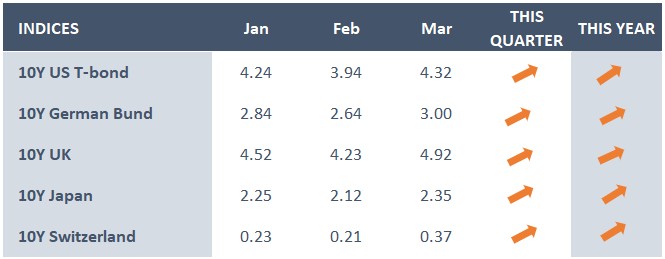
The ECB kept rates unchanged at 2.00% during Q1 but signalled that it could raise rates if inflation accelerates, particularly due to higher energy prices.
-
European government bond yields rose as markets reassessed the inflation outlook and the potential for tighter monetary policy.
In the US
-
The Fed kept rates unchanged at 3.50%–3.75% during the quarter while maintaining a cautious stance.
-
US Treasuries were relatively resilient and ended the quarter broadly flat, supported by the US being less exposed to rising energy prices and signs of a cooling labour market.
In the UK
-
The Bank of England kept rates on hold at 3.75% but adopted a more hawkish tone as rising energy prices increased inflation risks.
UK government bonds declined, with gilts among the weakest performers as markets moved away from pricing rate cuts.
In the Rest of the World
- The Bank of Japan kept rates unchanged at 0.75% but highlighted rising inflation risks linked to higher energy prices. Japanese government bonds declined as expectations of fiscal support and inflation pressures pushed yields higher.
- Emerging market debt weakened over the quarter, pressured by a stronger US dollar and increased geopolitical risks, which reduced investor appetite for riskier sovereign issuers.
Macroscope
Quarterly Macro & Market Review
1Q 2026
REVIEW BY ASSET CLASS
– CURRENCIES: Fiat & Digital
-
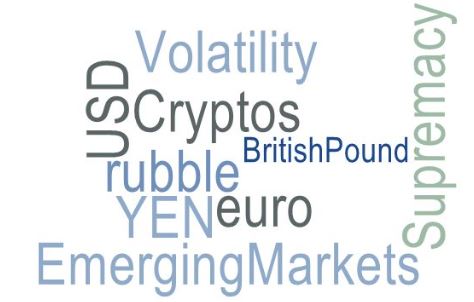
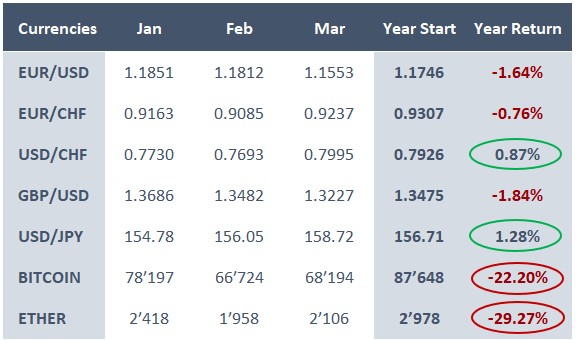
In Q1 2026, the USD strengthened as geopolitical tensions and rising oil prices triggered a risk-off environment, driving demand for safe-haven assets. The shift in rate expectations—from cuts toward potential hikes—also supported the dollar.
-
EUR weakened against the USD as higher energy prices raised concerns about growth and inflation in the eurozone, increasing uncertainty around the policy outlook. GBP also softened, reflecting the UK’s sensitivity to rising energy costs, although moves were more contained.
-
The JPY remained weak despite some policy support, as higher global yields and persistent inflation concerns limited its appeal, even as Japan maintained a relatively accommodative stance.
-
Digital assets declined over the quarter as risk appetite deteriorated. Crypto continued to behave like high-beta assets, falling alongside equities as investors reduced exposure to riskier segments.
Macroscope
Quarterly Macro & Market Review
1Q 2026
REVIEW BY ASSET CLASS
– COMMODITIES
-
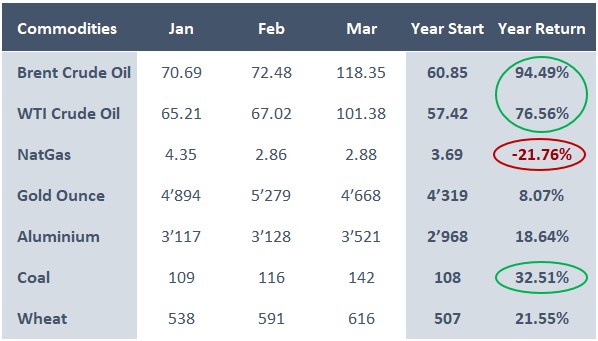
Commodities delivered substantial returns in Q1.
-
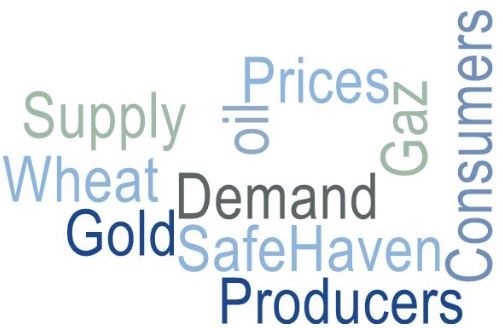
Energy prices surged after the conflict disrupted Middle East oil and gas production and shipping routes. The Strait of Hormuz — a key route for around 20% of global oil supply — was effectively closed, also impacting Nat Gaz and fertiliser exports. Saudi Arabia redirected part of its oil flows through its East-West pipeline, while some energy infrastructure, including in Qatar, was damaged.
- Natural gas prices moved lower this year and, unlike oil, did not rally sharply during the March Middle East tensions. The main reasons were mild weather reducing heating demand, seasonal weakness after winter, and continued oversupply from strong US production. While disruptions in Qatar and the Strait of Hormuz tightened global LNG markets, the US was still producing abundant gas, which helped cap prices despite higher oil prices.
-
Elsewhere, the agriculture, livestock and industrial metals components registered smaller positive returns.
-
Precious metals also registered a positive return for the quarter but saw sharp declines in March. Those falls in March may have partly been due to profit taking after a strong run previously for both metals. Additionally, expectations of higher interest rates weighed on the attraction of gold and silver which offer no yield.

Macroscope
Quarterly Macro & Market Review
1Q 2026
IN THE FUTURE
– WHAT THE SPECIALISTS SEE FOR 2026
Dr Alexis Crow, Chief Economist, PwC
“The global economy has shown real staying power. But resilience in 2026 isn’t automatic or evenly distributed. It relies on AI-driven investment, supportive fiscal policy and confidence in financial markets — and each of those comes with new constraints.“
Jamie Dimon, CEO, JPMorgan Chase
“There are lots of tailwinds in 2026. But there are large risks still in front of us that are multi-year and unresolved.”
Ray Dalio, Founder, Bridgewater Associates
“We face a breakdown of the monetary order. Do you print money, or do you let a debt crisis happen?“
Jerome Powell, Fed Chair
“Inflation expectations have climbed. The prospects for further rate cuts have significantly worsened.“
Larry Fink, CEO, Blackstone
“Markets are barely discussing fiscal discipline. When investors start questioning America’s trajectory, the real pressure begins.”
Macroscope
Quarterly Macro & Market Review
1Q 2026
FINANCIAL BUZZ
– THE NEW TERM TO MASTER TODAY
The Basis Trade: The $1 Trillion Bet Hidden Inside the World’s Safest Market
US Treasury bonds are supposed to be boring. That’s the point. But in April 2025, they became the epicenter of a market panic — not because of China, not because of tariffs, but because of a crowded hedge fund strategy that almost nobody outside Wall Street had heard of. Thousands of funds, all running the same leveraged bet, all hitting the exit at the same time. The Fed had to step in. Again. Here’s what the basis trade actually is, and why it keeps coming back to haunt the system.
Macroscope
Quarterly Macro & Market Review
1Q 2026
THE QUARTER AHEAD
– MAIN EVENTS & WHAT TO EXPECT

16-17 June: FOMC Meeting
First meeting under new Chair Kevin Warsh
What we can expect:
This will be the most-watched Fed meeting in years. Warsh takes over from Powell with core inflation at 3.2%, energy prices still elevated from the Iran conflict, and a White House pushing hard for rate cuts. Markets are pricing in a small but growing chance of a hike by year-end. Warsh will need to immediately establish his credibility — his tone at this first press conference will set the direction for the rest of 2026
11 June: ECB Governing Council Meeting
The ECB will assess a possible rate change.
What we can expect:
After holding rates at 2.0% in April, the ECB faces a difficult call. Energy prices remain elevated due to the Middle East conflict, pushing inflation back up after eight consecutive cuts. Lagarde has signalled a data-dependent approach with no pre-commitment. Some economists, including KPMG’s chief economist, have not ruled out a hike if energy pressures persist.
18 June: BoE MPC Policy Announcement
The Bank of England will meet to discuss a possible rate move
What we can expect:
The BoE held at 3.75% in April with one member already voting for a hike to 4.0%. Inflation is projected to rise further in Q3 and Q4 driven by energy and food prices. The Bank has explicitly warned it “stands ready to act” — making June a live meeting where a 25bps hike is a real possibility.