
Macroscope
Quarterly Macro & Market Review
3Q 2026
By Sophie Metulescu
with the collaboration of Loïc Lerch
Market Performance
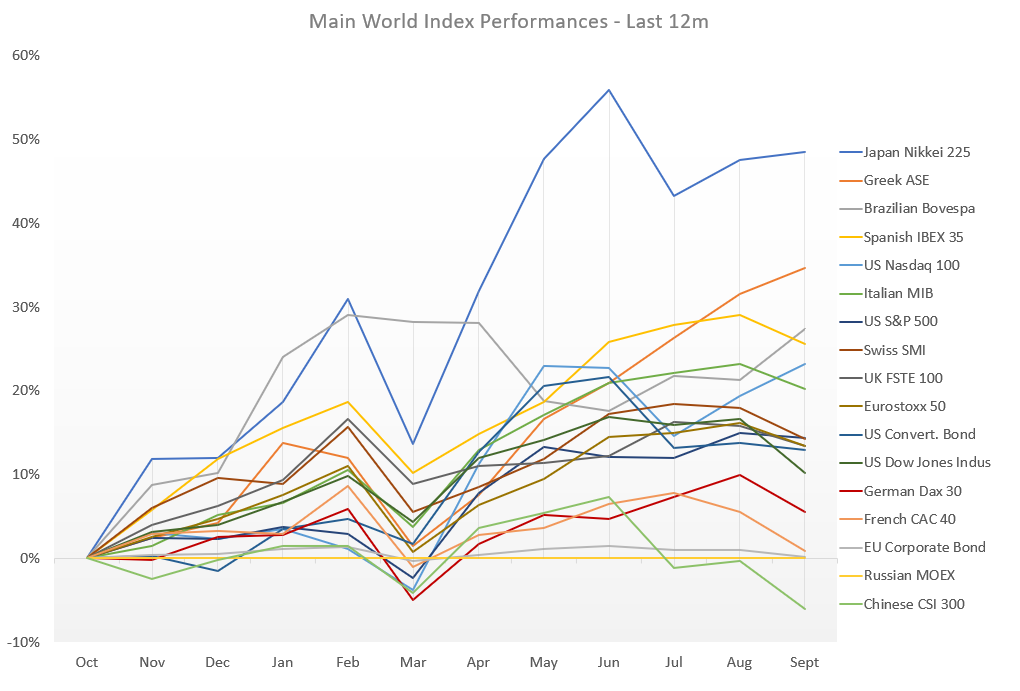
Data source: Bloomberg. Performances in base currency.
Macroscope
Quarterly Macro & Market Review
3Q 2026
– EQUITIES

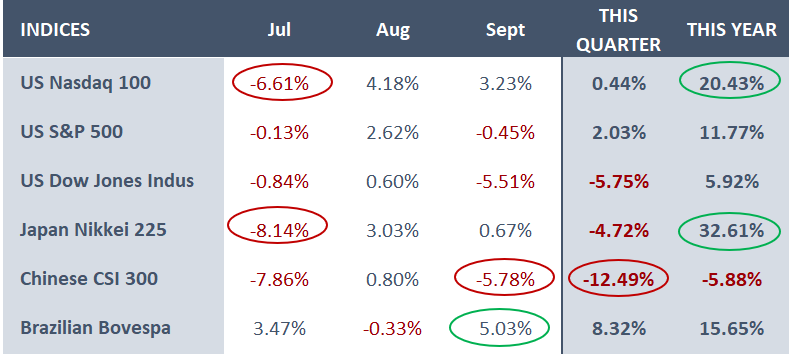
Global equities gained in Q3 2026 supported by strong corporate earnings, and enthusiasm around AI and digital infrastructure remained a key driver, while European equities declined slightly, amid renewed Middle East tensions, higher energy prices and rising interest rates.
Equity investors continued to favour strong earnings and long-term growth themes, despite rising yields and persistent inflation concerns.
Sources: Schroeders, Bloomberg, Yahoo Finance, JP Morgan, Reuters
In Europe
-
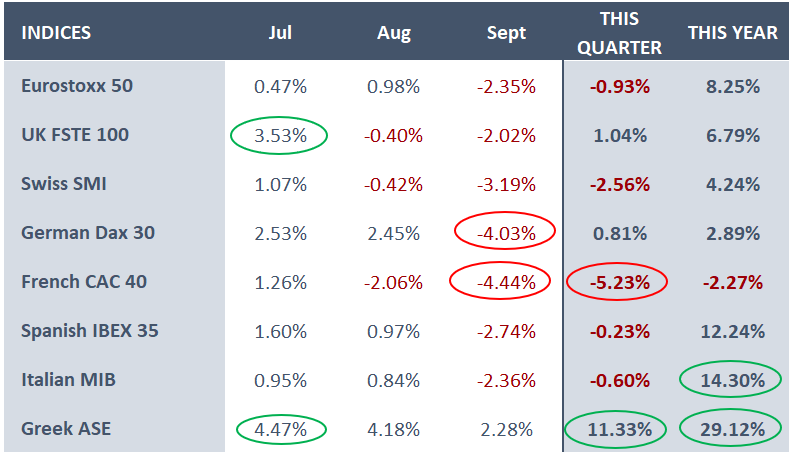
Quarter in review: Eurozone equities underperformed as weaker earnings growth and limited AI exposure left Europe behind the US and Asia.
-
Top-performing sectors: With no surprise, Oil Supermajors won the medal this quarter. Financials and materials also advanced, supported by strong bank earnings.
-
Laggards and concerns: Real estate and consumer discretionary were the weakest sectors, as higher rates and inflation weighed on rate-sensitive and consumer-exposed areas
In the US
- Quarter in review: US equities advanced thanks to healthy corporate earnings despite higher bond yields and energy prices.
- Top-performing sectors: Led by a wider profit margin Energy overperformerd once again. IT performed strongly on continued demand for AI and long-term technology spending. Healthcare also gained after greater clarity on drug pricing rules.
- Laggards and concerns: Utilities, often chosen for being good dividends-givers, became less attractive as rising bond yields offered investors better returns with lower risk.
In the UK
-
Quarter in review: UK equities rose, supported by strong gains in Energy despite rising inflation and a more uncertain policy backdrop.
-
Top-performing sectors: Besides the energy sector, telecommunications, technology and basic materials also posted solid gains.
-
Laggards and concerns: Healthcare underperformed, partly due to several clinical trial failures of AstraZeneca.
In the Rest of the World
-
Quarter in review: Emerging market equities edged slightly lower, weighed by fading AI momentum. Japan moved higher, supported by strong earnings and gains in financials.
- Top-performing sectors: South Africa benefited from higher precious and industrial metal prices, while Brazil was supported by commodities and easing inflation. Greece delivered double-digit returns as major index providers upgrade it from Emerging to Developed Market status, widening access for international investors attracted by the Greek stock market’s strong returns. (+125% in 3 years).
-
Laggards and concerns: Korea was the weakest major EM market as semiconductor and memory stocks corrected sharply, while India also underperformed amid higher elevated valuations and rising rate expectations.
Macroscope
Quarterly Macro & Market Review
3Q 2026
REVIEW BY ASSET CLASS
– FIXED INCOME & FISCAL POLICIES
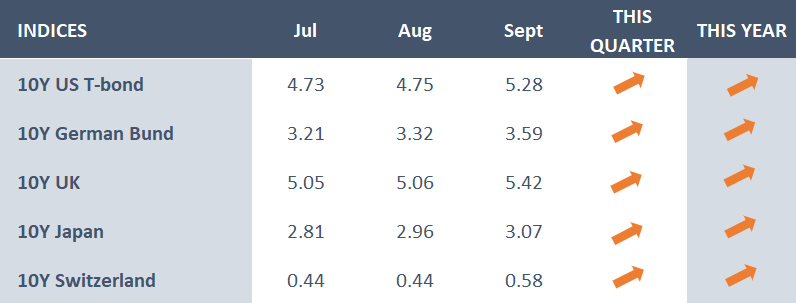
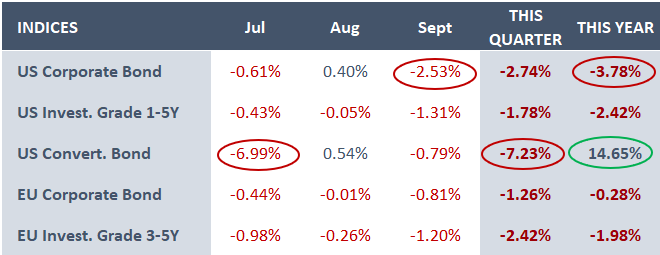
Global bond markets weakened in Q3 as higher energy prices revived inflation and pushed central banks towards tighter policy. Government bond prices fell as yields rose sharply across major markets, with several reaching 10-year highs. Corporate bonds fell less, supported by solid company fundamentals and attractive yields. High yield performed better than investment grade, helped by higher income and lower sensitivity to interest-rate moves.
Overall, Q3 was challenging for fixed income, as rising inflation and higher yields pressured bond prices.
Sources: Eurostat Data, the US Bureau of Economic Analysis, Reuters

In Europe
-
The ECB raised rates by 25bps to 2.50% in September, as raising energy prices pushed eurozone inflation back to 3.2% in August. The ECB also warned that inflation could remain above target for longer
-
German Bund yields reached 3.6%, their highest levels since 2011, while French government bond spreads versus Germany widened sharply because of growing fiscal concerns.
In the US
-
New Fed Chair Kevin Warsch raised rates by 25bps to 3.75–4.00% in September, its first hike since 2023, as inflation remained elevated and growth resilient.
-
US Treasuries fell sharply, with the 10-year yield ending Q3 at about 5.3%, versus 4.2% at the start of September, as higher energy prices and stronger growth pushed expectations towards higher-for-longer rates.
In the UK
-
The Bank of England kept rates unchanged at 3.75% in September, despite inflation rising to 3.1%, as policymakers weighed renewed inflation pressures against signs of weaker domestic growth.
-
UK gilts faced strong selling, with the 10-year yield rising above 5.3% during September, its highest level since before the 2008 financial crisis, as higher oil prices and expectations of future BoE hikes pushed borrowing costs higher.
In the Rest of the World
- The BoJ raised rates to 1.25% in September, a 31-year high, as the nippon inflation remained. Japanese government bonds also fell with the 10-year JGB yield rising above 3.0%, its highest level in around 30 years.
- More broadly, bond markets outside the US and Europe were also pressured by the global rise in yields.
Macroscope
Quarterly Macro & Market Review
3Q 2026
REVIEW BY ASSET CLASS
– CURRENCIES: Fiat & Digital
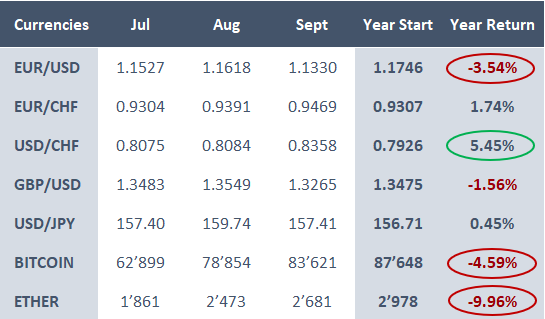
- The USD strengthened late in Q3, supported by higher US yields, and expectations of further Fed tightening even more in September as energy-driven inflation revived rate-hike expectations.
- The EUR weakened against the USD, fiscal concerns and a weaker growth outlook despite the ECB hike. GBP proved more resilient, supported by further BoE tightening.
- The JPY recovered from near 40-year lows after rare US–Japan intervention and expectations of further BoJ tightening.
- Digital assets rebounded strongly, with Bitcoin gaining about 43% and Ether around 71%, as the CLARITY Act setback was followed by SEC approach to bring clearer rules to US crypto regulation.
Macroscope
Quarterly Macro & Market Review
3Q 2026
REVIEW BY ASSET CLASS
– COMMODITIES
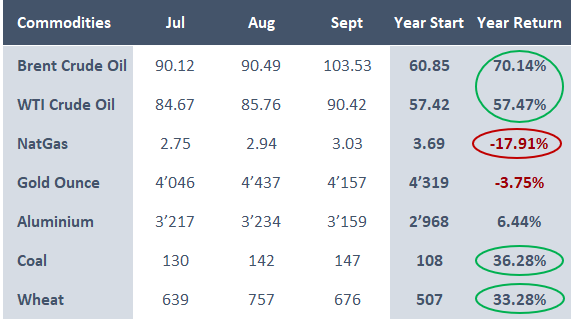
- Commodities rose strongly in Q3, with the S&P GSCI driven mainly by energy as geopolitical tensions and supply disruptions returned to the forefront.
- Energy: As the Strait of Hormuz disruption remained unresolved, with shipping still well below normal and damaged oil export infrastructure tightened supply expectations. Oil Price resumed climbing at high level.
- Agriculture advanced as El Niño threat and renewed attacks on agricultural exports in the Russia–Ukraine conflict raised supply concerns.
- Industrial metals also gained, supported by tighter supply, particularly in copper, where concentrate shortages and mine disruptions constrained availability.
- Precious metals rose moderately. Gold benefited from safe-haven demand.

Macroscope
Quarterly Macro & Market Review
3Q 2026
IN THE FUTURE
– WHAT THE SPECIALISTS SEE FOR 2026
Dario Amodei, Anthropic
“We must slow the pace at which we improve the capabilities of AI models.”
Larry Fink, CEO de BlackRock
“I’m very bullish on the markets over the next 12 months.”
Mohamed Kande, Global Chairman, PwC
“CEOs are adapting to an environment where disruption has become the new normal.”
Christine Lagarde, President, ECB
“Europe already has too little data centre capacity to meet its own demand… Europe needs to build at a different pace altogether.”
Andy Burnham, UK Prime Minister
“Brexit has done more harm than good … we could go all the way” — referring to full EU membership.
Macroscope
Quarterly Macro & Market Review
3Q 2026
FINANCIAL BUZZ
– THE NEW TERM TO MASTER TODAY

Do you know what is Neocloud?
-The rise of AI-native cloud infrastructure
Neoclouds moved from niche GPU providers to major AI infrastructure players as demand for computing power surged.
Unlike traditional cloud providers such as AWS, Azure or Google Cloud, neoclouds focus entirely on AI computing by giving access to the massive computing power, they have quickly become a hot investment theme.
Their rapid growth also brings risks: high capex, debt, fast technology obsolescence and reliance on a few large customers.
Macroscope
Quarterly Macro & Market Review
3Q 2026
THE QUARTER AHEAD
– MAIN EVENTS & WHAT TO EXPECT

12–18 October: International Monetary Fund & World Bank Annual Meetings
The IMF will release its new World Economic Outlook on 13 October, alongside its Global Financial Stability Report and Fiscal Monitor.
What we can expect:
The meetings should provide the first comprehensive global outlook after the recent energy shock, rise in bond yields and renewed inflation pressures. Growth resilience, sovereign debt sustainability and the risk of structurally higher interest rates will be key themes.
27–30 October: Central Bank “Superweek” – Fed, ECB & BoJ
The Fed meets on 27–28 October, the ECB on 28–29 October, and the Bank of Japan on 29–30 October.
What we can expect:
The Fed is currently expected to pause in October after September’s hike, although another increase remains possible in December if inflation stays persistent.
The ECB faces similar pressure as higher energy prices have pushed euro-area inflation back up.
The BoJ is increasingly signalling that rate hikes may need to come faster and more regularly.
3 November: U.S. Midterm Elections
Americans will elect the full House of Representatives and part of the Senate.
What we can expect:
The outcome will determine how much room the Trump administration has to pursue its fiscal, tax, trade and regulatory agenda during the second half of the presidential term. Markets are likely to focus particularly on the implications for deficits, tariffs and Treasury issuance.
9–20 November: COP31
COP31 will take place in Türkiye, with Australia leading the negotiations.
What we can expect:
Energy security is likely to complicate climate negotiations after another year of geopolitical disruption. Investors will watch for developments on climate financing, energy infrastructure and the pace of the transition away from fossil fuels.
8–18 December: Year-End Central Bank Decisions
The Fed meets on 8–9 December, followed by the ECB and Bank of England on 17 December and the BoJ on 17–18 December.
What we can expect:
This should be the quarter’s most important monetary-policy sequence. Markets will get a clearer picture of whether the 2026 energy-driven inflation resurgence is temporary or whether higher rates will need to extend into 2027.
Through Q4: Iran War, Hormuz & the Oil Market
What we can expect:
Qatar-mediated U.S.–Iran talks will be key to whether the conflict de-escalates. With Hormuz still partly restricted, failed negotiations could trigger renewed fighting, tighter oil supply and another inflation shock.
Through Q4: Russia–Ukraine – The Winter War
What we can expect:
The war is entering another critical winter phase, with Russia targeting Ukraine’s infrastructure and Ukraine stepping up strikes on Russian energy assets. Further escalation could pressure European gas markets, Russian fuel exports and defence spending into 2027.